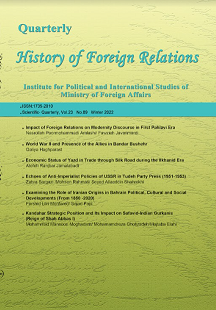
Foreign Relations History

Foreign Relations History

  • Journal title: History of Foreign Relations (HFR)
  • Country: Iran
  • Publisher: Ministry of Foreign Affairs(Details)
  • Category: History of Iran's foreign relations
  • Type of published articles: Research, promotion (is included on the first page of each article, according to Article 2, Clause 6 of the Ministry of Science's Journals Commission Regulations).
  • Month and year of publication: December 1999
  • Credit of the journal: Scientific
  • Language: Persian with English abstract
  • Journal Frequency: Quarterly 
  • Format: Printed & Online
  • The cost of reviewing and publishing the article: Free
  • Period of initial review of articles: 10 days
  • Process of Review: Two-sided anonymous
  • Review Time: 4 to 6 months
  • Acceptance percentage of articles: 29%
  • Use of similarity search before sending to arbitration: Yes (Samim Noor similar text finder system)
  • Access to Articles: Free (Open Access) & Full Text

https://economics.ihcs.ac.ir/data/ce/news/olive.jpg

https://economics.ihcs.ac.ir/data/ce/news/123.jpg


https://economics.ihcs.ac.ir/data/ce/news/open_acces_2.png

https://economics.ihcs.ac.ir/data/ce/news/olive.jpg

Contact the Journal

Address: Shahid Bahonar St. (Niavaran) - Shahid Aghaei St. - No. 30 - Institute for Political and International Studies, Ministry of Foreign Affairs

Postal Code: 1936783314

Email: journalhistory3@gmail.com

Tel: 22802671-5, Extension 3126

https://economics.ihcs.ac.ir/data/ce/news/olive.jpg


Keywords Cloud

  • Iran
  • Iran
  • Foreign Relations
  • Relations
  • Qajar
  • Safavid
  • Russia
  • Persian Gulf
  • Britain
  • Foreign Policy
  • Ottoman
  • Persian Gulf
  • China
  • England
  • Political Relations
  • Qajar Era
  • Trade
  • Japan
  • Second Pahlavi
  • India
  • Qajar Dynasty
  • Ottoman Empire
  • Economic Relations
  • Safavids
  • Turkey
  • India
  • Afghanistan
  • Germany
  • cultural relations
  • World War II
  • Safavid Era
  • Ottomans
  • Trade Relations
  • Mongols
  • Ilkhanate
  • Georgia
  • Oil
  • Bahrain
  • Pahlavi II
  • Foreign Trade
  • Ambassadors
  • Second World War
  • Shah Abbas I
  • Azerbaijan
  • Europe
  • Ilkhanids
  • Pahlavi
  • Silk Road
  • Education
  • Mashhad
  • Safavid Empire
  • Constitutional Revolution
  • Italy
  • America
  • Tehran
  • Ilkhanates
  • Economy
  • Invasions
  • Soviet Union
  • Allies
  • Sassanids
  • Caucasus
  • World War I
  • Diplomatic relations
  • USSR
  • Qajars
  • Pakistan
  • migration
  • Extremism
  • the Caucasus
  • Safavid Dynasty
  • Kurds
  • the Persian Gulf
  • Iraq
  • ECO
  • Iran-Ottoman Relations
  • Ministry of Foreign Affairs
  • Politics
  • Basra
  • Sogdians
  • Tbilisi
  • Oman
  • Iranian Immigrants
  • Africa
  • Ommanant
  • Europeans
  • Analysis
  • Negotiations
  • The Qajars
  • Uzbek
  • Diplomacy
  • Embassy
  • Soviet
  • Conflicts
  • British
  • technology
  • Transoxiana
  • Treaty of Turkmanchai
  • second Pahlavi era
  • Golden Horde
  • Dunbulid House
  • constitutional
  • United Nations
  • Central Asia
  • cultural diplomacy
  • Bandar Abbas
  • Iranian Art
  • bilateral relations
  • Modernization
  • Reza Shah
  • Anatolia
  • Kandahar
  • the Second World War
  • Zand
  • Iraq
  • Views
  • Pahlavi the first
  • Shah Sultan Hussein
  • Shibkooh
  • culture
  • the USSR
  • All-e- Afrasiyab
  • Naser al-Din Shah
  • Egypt
  • Nadir Shah
  • Khoy
  • France
  • Kalat
  • USA
  • Fath ali Shah
  • Lengeh Port
  • British Consulate
  • Gorzeh
  • Immigration
  • Shah Abbas II
  • Court
  • mysticism
  • Afsharids
  • First Pahlavi
  • Azerbaijan Crisis
  • Consequences
  • art
  • the Allies
  • Afsharid Dynasty
  • East India Company
  • Jews
  • Consulate
  • evaluation
  • Iranology studies
  • Cultural Consequences
  • Political despotism
  • Zand Period
  • money dealing
  • Charge d’affair Office
  • Political and Military Role
  • Close Ties
  • Trade Weapon Smuggling
  • Tabriz Carpet
  • Ulus Jochi
  • Diplomatic documents
  • Razmara
  • Fire arms
  • Great Britain
  • rule
  • North Caucasus
  • Member States
  • Economic Status
  • Modernity Discourse
  • World Heritage
  • centrifugal tribes
  • ayyobian
  • Graham Alison\'s Theory
  • Afshari
  • Helmand Water Crisis
  • Activism of Government
  • HosseinQoli khan
  • Kish Island، mongol era، economical changes، bani gheisar kings،continuing
  • emergence
  • Bandar Bushehr
  • Adib Pishawari
  • An Iranian Approach
  • Khwarazm
  • Customs Proceeds
  • Press
  • banditry
  • Jungle Movement
  • Barāq
  • Four Sunni Schools of Religion
  • merchants
  • Indians
  • 531 AD)
  • Seljuks
  • Model of Crisis Management
  • Mirza Malkam Khan Nazemoddoleh
  • Jahangir Shah
  • court of the Mongols
  • economical importance
  • Qajar government
  • the Timurids
  • International System